Minimal CJK for Go
42 views
20 de setembro de 2026
It's surprising how knowing just a few words can give us so much access to what's shared in the main Asian languages for Go, i.e., Chinese, Japanese and Korean.
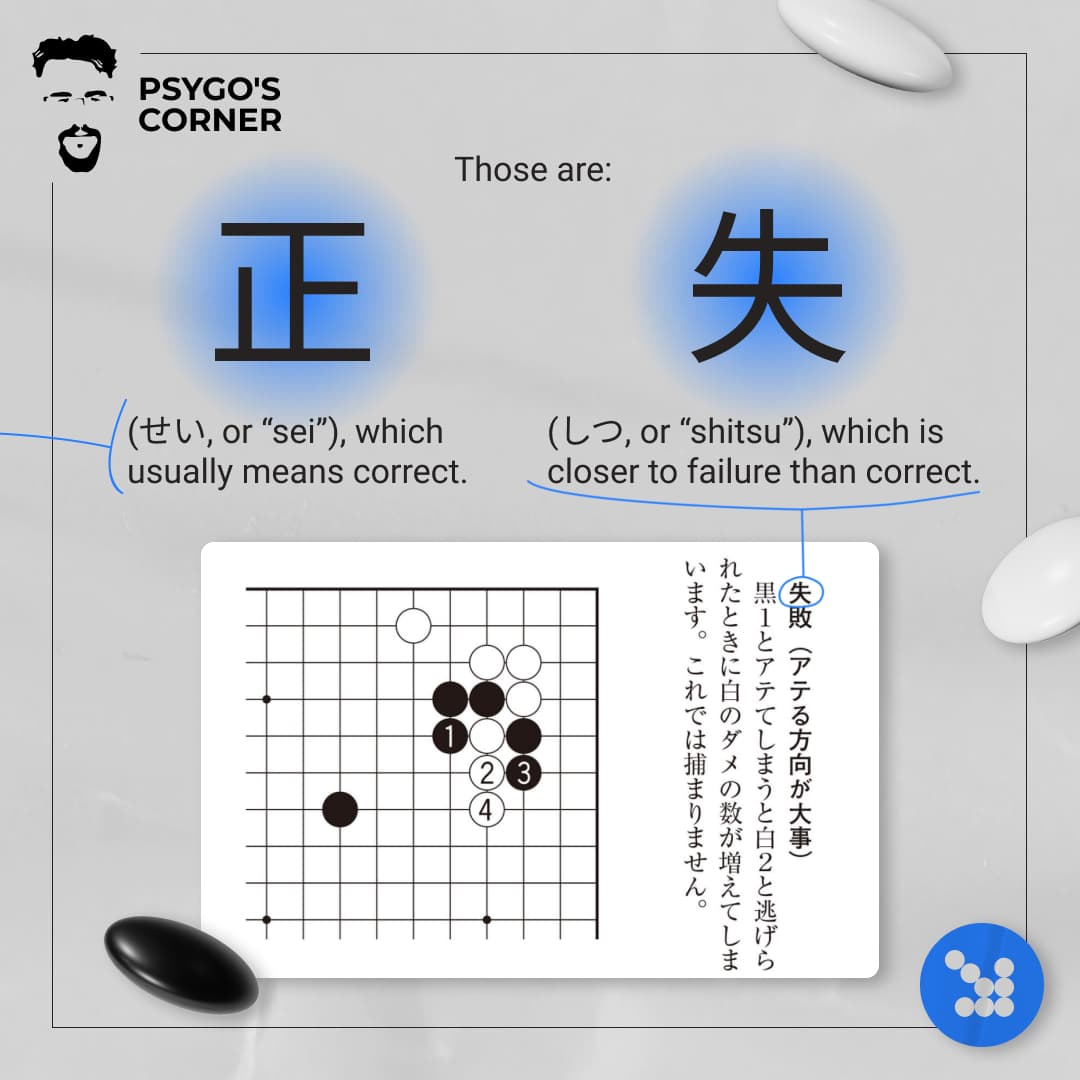
With just "black", "white", "correct" and "incorrect", you're already able to read most problem books, which covers a lot of all Go literature has to offer.
| English | Chinese | Japanese | Korean |
|---|---|---|---|
| Black | 黑 | 黒 | 흑 |
| White | 白 | 白 | 백 |
| Correct | 正 | 正 | 정 |
| Incorrect | 失 | 失 | 실패 |
If you have any addition suggestions to this table, let me know!
As with any language, there are nuances to different contexts, for example, the terms for "incorrect" that I listed above are closer to "failure" usually. And it's not always that the different terms listed above will be the correct ones. Nonetheless, those likely cover more than 90% of all usage.
My article on this topic for Go Magic.
If you're interested in learning Japanese specifically, in a post on my now inactive "psygo's Corner" for Go Magic, I recommended Richard Hunter's books as an intro to that language. His two main series are: Just Enough Japanese and The Road to Understanding Japanese, both available on Go Books. I highly recommend all Go players to try out the first volume of JEJ, as it opens the door to a new language — and a new way of thinking! — in a very short amount of time.

Richard Hunter's introductory book on Japanese for Go players.
My knowledge of Japanese and Korean doesn't go that far unfortunately, and my Chinese is infinitesimal. However, two of the best resources I know for Japanese and Korean are:
- Jisho, which actually means dictionary (辞典) in Japanese.
- Naver's Korean-English Dictionary, which also shows the Chinese characters originating many of the Korean words or compounds.
Some linguists and polyglots highly recommend learning multiple languages in parallel and comparing them to each other. That might veer towards their inherent interest in languages as a whole, but, overall, I find that method to be much more engaging than learning only one language at a time. Of course, you're perhaps stretching yourself too thin, but we're not robots, we need to feel motivated, if it works for you, then it might just be the correct approach after all.
Comentários
Você precisa entrar na sua conta para comentar.
I know of two reference books on this subject.
-Go Terms Definitions & Translations by Chihyung Nam.
-Dictionary of Weiqi Terms English-Chinese by Weiqi Association of China.
When there is a tough term I cannot find I search one of them and Sensei's Library. There was a common terms pamphlet that was provided to me when I first purchased an Elementary Go problems series in Chinese Simplified in 2004, it is quite useful. I'll email it to you.